Thursday, March 5, 2015

Maker Fair


For this assignment, we were supposed to choose and research a game that inspired us. I don't game all that often so I really don't know much about games. One game I often play, especially when friends are over, is Super Smash Bros. Melee on GameCube. Most of the time we'll play multiplayer mode where everyone plays against each other, with or without teams, and try to collect little rewards or coins. One player mode, there's lots of different things you can do but I haven't played that often enough to really remember what happens.
For development, it was developed by HAL Laboratory with Masahiro Sakurai at the head of production. HAL worked with 3 different graphic houses to make the opening sequence. It was in development for 13 months. After making Super Smash Bros., they wanted to create an even better sequel.
Why this game is so intriguing to me is because it keeps me and friends entertained for a long time and we always want to come back and play it again. I don't normally keep up with playing most games but this game is great and I can always get back to it any time.

Monday, March 2, 2015

Automoblox

Product: Automoblox signature series X9-SE
Manufacturer: Automoblox

Front


Side


 Back Isometric


Front Isometric

The car uses mostly curves in its design, putting aside the lines for the doors. It is balanced and symmetrical, applying a sense of sturdiness through the use of wood. The red and black are complementary of each other on the car. The texture of the car itself is quite smooth while the wheels are rough and very realistic to the tires of a real car in look and feel.

The purpose and primary function of the toy card are to roll around and keep children entertained. Regarding the wheels, they don't fall off upon spinning because if we look at the axle, it has a stopper that is wider at the ends to stop the wheels from falling off. The end is split so that they can be pushed together and made smaller when trying to remove and put in the wheels but then expand again to its normal size when put in place.


Sketch


Wheel


wheel with axle


Car parts chart


How do visual design principles and elements impact the commercial appeal of a product?
If it is curved, smooth, and sleek, it is more enticing for children to want as well as for parents to buy for their children.
What does a black box represent in the system input/output model?
It represents the building of the product.
Why do engineers perform reverse engineering on products, and how would you describe it in your own words?
Engineers reverse engineer products to get to know the product better and see what restrictions they have to work with when improving or adding on to a product.

Saturday, February 21, 2015

Cad drawing practice

For this project, we were given different parts with their dimensions to reverse engineer. Not all dimensions were given so we had to do a bit of math to get every dimension needed. We started with a passenger base of which we had to make different shapes within the base. The one I had the most difficulty with that I couldn't get help on was the star.
Unfortunately I couldn't open up the file in my inventor for it and I was told to move on to another project so I don't have an image for this.

Shelter project : Geometric constraints


For this project we were given 30 toothpicks and dots to connect them all.
1. We chose triangles because triangles are well known for being a very sturdy shape. We used a hexagonal base with triangles within it meeting at the center. The walls were various pyramids all have one point meeting in the center as well and we have two toothpicks crossing eachother in the middle to keep the pyramids from moving around. We placed a textbook on top and it stayed together very well.
2. The angles we got were 60° equilateral triangles or 30°-60°-90° right triangles within our structure.
3. not including the base, the overall surface area of the exteriors was 28.25 square inches. It would require 28.25 square inches of wood as my material.
4. The overall surface area of the interior was around 44.49 square inches. If the gumdrops were the people, about 30 people would be able to fit inside. 
5. Our shelter size was limited due to the fact that we were only given 30 toothpicks and 12 gumdrops.
6. Our design was very strong and stable so that it supported our chemistry textbook.

Wednesday, February 11, 2015

Big question


For this project, we had to ask ourselves a question about inventor that we are unsure of how to answer. Mine was, "How do you make a sphere in inventor?" I searched through Youtube and found a tutorial: Autodesk Inventor Professional 2015 - How to Make a Sphere: http://youtu.be/psbjvl6kaH4
It was very helpful and answered my question.


My next question was how to make a cone, but I also wanted to hollow out the bottom of the hole. I didn't use a tutorial but I had Benjamin give me some guidance with the tools to create this cone.

I first created a square and made a line from one corner to another, then trimming off the two sides to create a right triangle. I next used the offset tool to create another, smaller triangle within this triangle. Then you click move, shift click the three sides of the smaller triangle, and select base point. A message will pop up asking to remove the constraints of which you click yes and move the smaller triangle to the point of origin and then click done. Now you would click on the line tool and coonect the top corners of the triangle and the bottom corners of the triangles, then trimming the access inner lines.
You finish the 2-d sketch and then click rotate, selecting the tip of the poential cone axis to revolve it on. Press okay and then you have a hollowed out cone.

Friday, February 6, 2015

Salt and Pepper Shakers

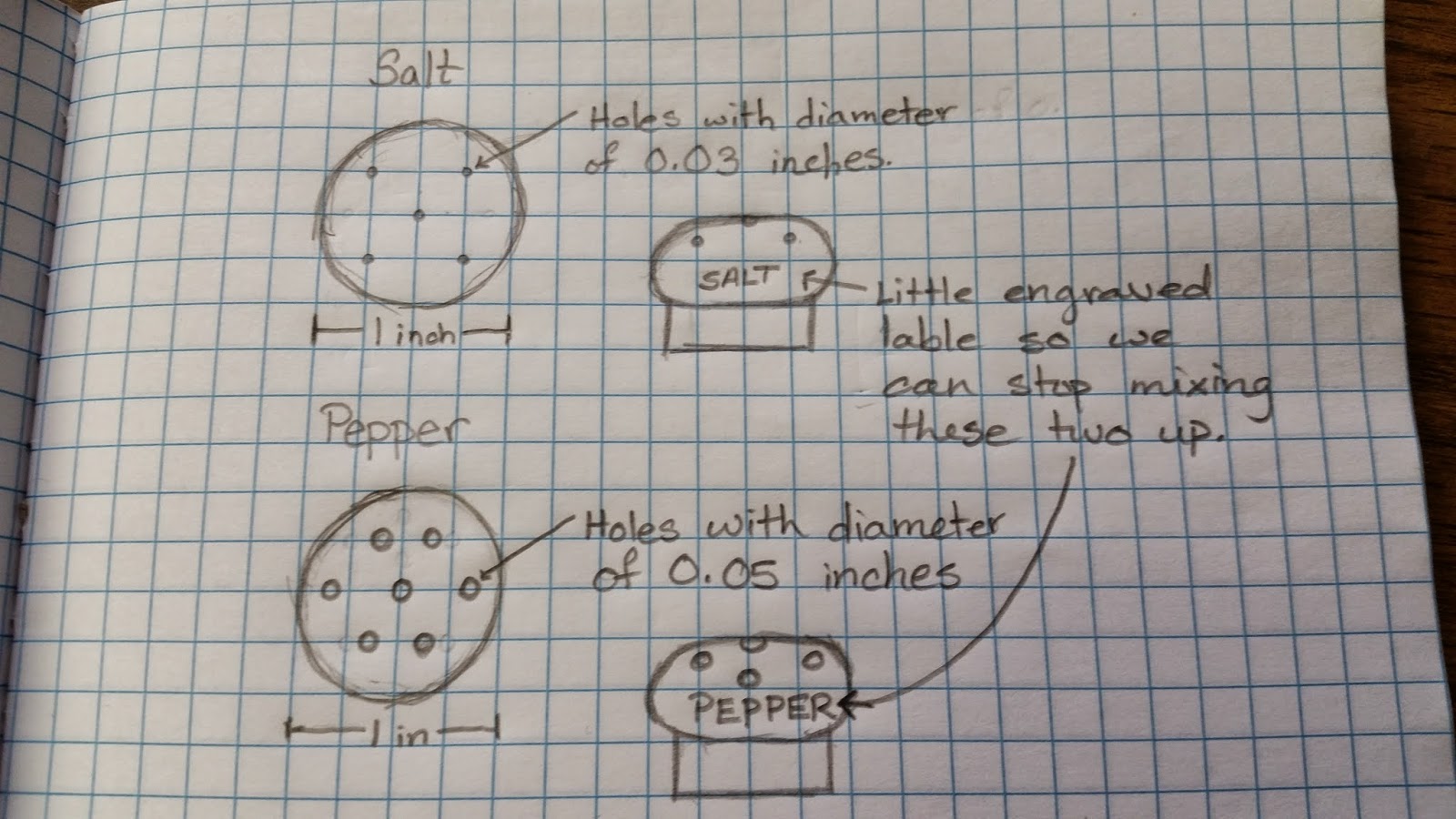
 For this project, we had to find something where form doesn't correlate with its functionality. For me, I chose salt and pepper shakers because they're a subject that really annoys me in the areas where company's that design beautiful products can't tell that there is a significant difference between salt and pepper that should make their designs different. Not to mention, restaurants are always mixing the two up, so the rate of which the salt and pepper exit the container are way too different.

*read more in my wibbly wobbly timey wimey bendysnaps cucumberface filled presentation in the below link ^v^*

 https://docs.google.com/presentation/d/1-UFVgpFMJZMTHyvCNIs32J2j173RPr1bVzzqP3_zWs8/edit?usp=sharing


The feedback I received on my design didn't really involve my design but more the gifs I used...

But overall, if we could get all companies that design dining ware to take this into consideration, the world would be a better place.

Monday, February 2, 2015

Puzzle part 2


After we designed the puzzles on paper, with blocks, and on inventor, we got to make our parts with 0.75 inch blocks by gluing them together with wood glue. Once these parts were created we had 5-10 people try to solve the puzzle. Most had managed to solve the puzzle in 15 minutes or less, averaging about 14.5 minutes. Above is the data and histogram for the times recorded per trial as well as the mean (14.458), median (14.75), mode (15), and standard deviation (11.42796).
Along with having our puzzles tried out by 10 people, we had to make cad drawings in inventor for each piece with different angles and dimension labels.